
This call for proposals has two funding lines:
- Conservation of MRS Natural Resources
This funding line refers to the protection, management, and/or restoration of ecosystems and natural resources, with the objective of ensuring their permanence and that of the environmental services they provide. This funding line may include activities such as biodiversity monitoring, ecosystem restoration measures, protection of migratory routes and aggregation zones, creation, expansion, or strengthening of fisheries recovery zones, and implementation of best conservation practices, among others.
- Sustainable Use of MRS Natural Resources
This funding line refers to responsible natural resource use practices that yield social, cultural, and economic benefits in the present while maintaining their potential for future generations. This funding line may include market activities based on the sustainable use of natural resources, generation of alternative income, sustainable fishing, and low-impact tourism, among others.
The priority ecosystems and resources for Phase III are mangroves, seagrass beds, coral reefs, and fisheries.
Applicants are invited to develop projects that cover one or both of the funding lines described above.
Projects must directly contribute to the achievement of the general objective, results, and indicators of Phase III detailed below:
Objetivo general:
Conservation and sustainable use of natural resources in and among the selected Marine-Coastal Protected Areas (MCPAs) of the Mesoamerican Reef System (MRS).
Resultados:
- MCPAs have improved conditions for the conservation of their natural resources1,
- Measures implemented for the sustainable use of MCPA natural resources with the participation of local communities2 y
- Strengthened cooperation among key actors for MRS biodiversity conservation.
Indicadores de objetivo:
O1: area in hectares with improved conservation,
O2: area of relevant ecosystems with more sustainable use, and
O3: number of initiatives supporting the adaptation of vulnerable populations to climate change.
To align your project activities with the Phase III logical framework, please consult the Phase III Logical Framework. Review the Hoja Informativa del Phase III Logical Framework for greater clarity on the indicators.
1Expected result for proposals covering funding line 1 (Conservation of MRS Natural Resources)
2Expected result for proposals covering funding line 2 (Sustainable Use of MRS Natural Resources)
This first call for proposals is directed exclusively at the administrators/authorities and co-administrators of the 14 MCPAs selected through the second regional prioritization exercise for the MRS, conducted in 2016 and detailed below:
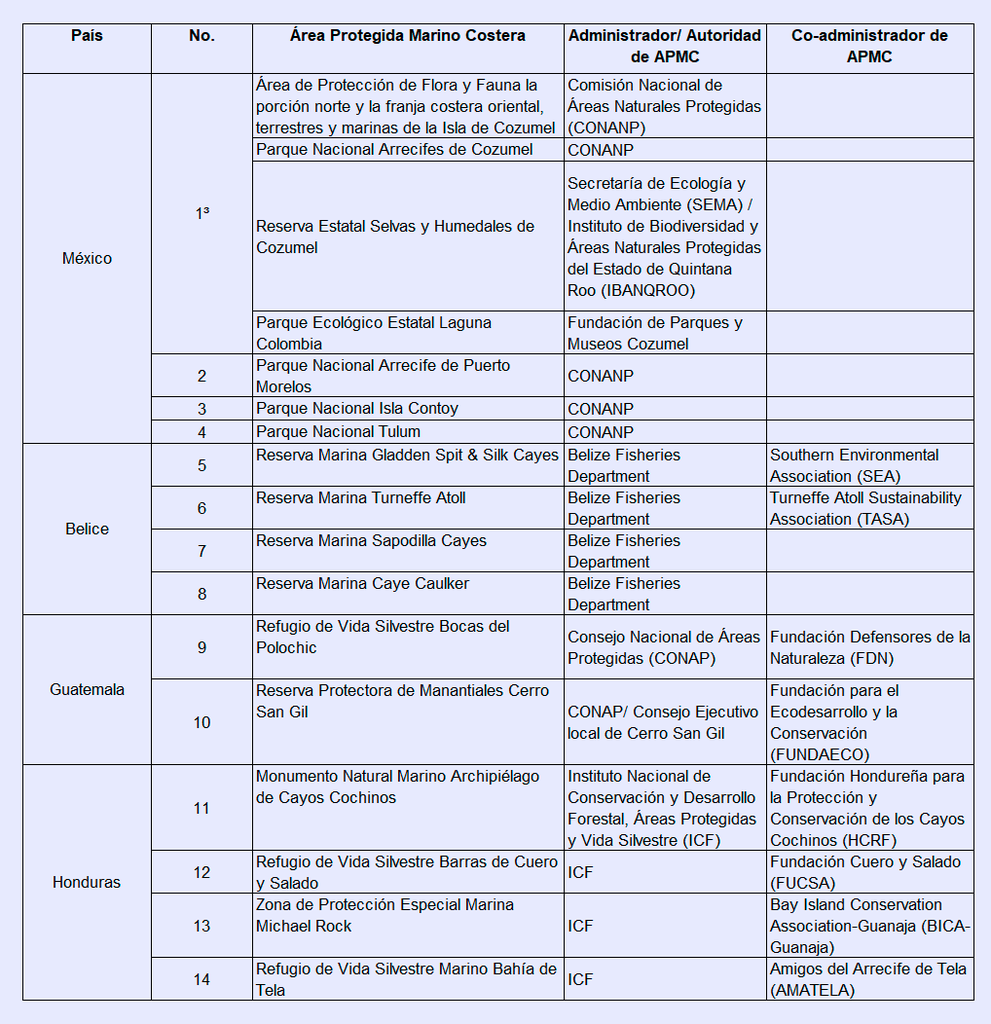
3 The four protected areas of Cozumel Island must jointly submit the concept note (CN) / project proposal (PP).
In this call for proposals, the applicant is defined as the administrator/authority or co-administrator of the 14 eligible MCPAs. A maximum of one project per eligible MCPA may be financed; however, applicants who wish to do so may submit more than one concept note per MCPA to be submitted for evaluation.
The four eligible MCPAs in Mexico must apply through a civil society organization (CSO), which will be responsible for administering the project funds. MCPAs managed by governmental institutions from other countries that do not have a co-administrator may, if they wish, also apply through a CSO, provided it is duly registered in their country. A CSO is defined as any duly registered, non-profit group of voluntary citizens, organized around specific objectives at the local or national level, that does not pursue personal benefits but rather benefits for society and its environment. In all cases, applicants will be the administrators/authorities or co-administrators of the MCPAs.
An additional positive factor in the evaluation process will be considered for proposals that include other MCPAs of the MRS (any other MCPA, not necessarily from the list of 14 mentioned above, whether from the same country as the applicant or from another) and/or contemplate activities that strengthen cooperation among key actors for MRS biodiversity conservation, including exchanges and/or collaborations with other MCPAs, thereby contributing to Phase III Result 3.
For each proposed project there must be only one applicant. In cases where proposals involve collaboration among several MCPAs, the applicant must be the administrator or co-administrator of one of the 14 eligible MCPAs. Please note that the applicant and the CSO, once defined, cannot change during the evaluation process of the proposed project.
Applicants may include, if they wish, activities to be implemented in the areas of influence of the eligible MCPAs. Each applicant must define these areas in the CN.
The minimum implementation period for projects will be 24 months and the maximum will be 36 months, beginning with the signing of the financial allocation agreement between MAR Fund and the applicant. The call for proposals process timeline is in section XII.
Projects may be submitted for amounts between US $350,000 and US $750,000.
The project budget must cover all directos costs necessary to implement it. For this call, at least 20% of the total project amount must come from other sources, as co-financing (in kind and/or cash).
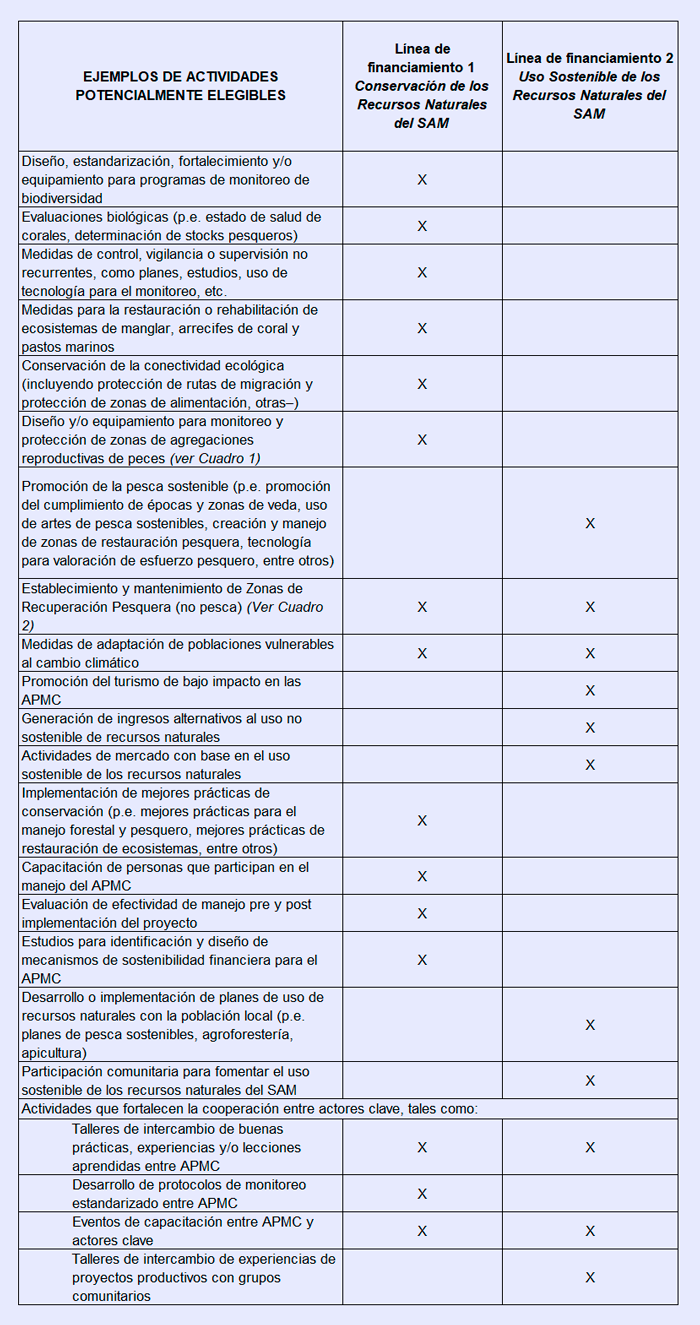
The following presents some examples of potentially eligible activities for the two Phase III funding lines. This is not an exhaustive list and other activities may be proposed, as long as they are related to one of the 2 funding lines. In addition, examples of activities that strengthen cooperation among key actors (Phase III Result 3) are included.
Expenses that can be financed with grant funds include, for example, the following: land vehicles, boats and motors, small infrastructure (e.g., docks, shelters, palapas), field equipment, supplies/materials, consultancies and specific studies (e.g., topographic and geotechnical surveys, soil studies, aerial prospecting and remote sensing, aerial photography, satellite imagery, cartography, and biological assessments), management effectiveness evaluation, travel expenses (international and domestic), training sessions, workshops and meetings, fuel for non-recurring activities, communications, evaluations or plans required to meet the commitments of the Environmental and Social Management System (ESMS), ESMS monitoring, registrations and/or research/restoration authorizations/permits, and direct MCPA administrative expenses (office furniture, desks, equipment and office supplies, consultant to coordinate the project, bank transfer costs), among others.
The cost of registrations and/or research/restoration authorizations/permits required by national or local government institutions may be included in your project budget from year 2 of implementation. Please note that registrations and/or permits required for the implementation of your project in the first year must be submitted before the signing of the financial allocation agreement.
Los gastos que NO se pueden financiar con fondos de Fase III son:
- Development or updating of MCPA management plans,
- Recurring expenses of the MCPA administrator/authority or co-administrator (such as office rent, fuel for recurring activities, staff salaries, recurring biological monitoring activities),
- Major infrastructure (e.g., administrative headquarters, field stations, control towers),
- Import duties, and
- Activities listed in the Exclusion List of MAR Fund’s Environmental and Social Policy.
MCPAs whose project is administered by a CSO may include in the budget the administrative cost of the project, which must not exceed 10% of the grant awarded by MAR Fund. All administrative expenses charged to the CSO must be included in this percentage, including, for example, bank transfer costs, administrative follow-up travel expenses, among others. No direct project expenses apply to CSOs. The administrative cost percentage is applied to the amount executed by the MCPA administrator or co-administrator.
The call for proposals consists of two stages: 1) preparation of concept note (CN) and 2) preparation of project proposal (PP).
CNs and PPs may be submitted in Spanish or English.
The applicant must register in the Project Management System (PMS) online of MAR Fund. After registering, the applicant will receive a notification email with system access credentials to submit their CN.
- Etapa 1 (Nota Conceptual):
To prepare the CN, applicants must download the Concept Note Format and the Annex 1. Environmental and Social Questionnaire, to complete them according to the instructions. The CN must include: applicant information, information on the CSO that will administer the proposed project funds (where applicable), information on the MCPA(s), description of the proposal, possible environmental and social risks, and estimated budget. More detailed information on how to complete the CN is found in the format instructions.
The complete CN, Annex 1, the required documentation, and any additional documents considered must be uploaded to the online PMS.
Applicants whose CNs have been approved to proceed to stage 2 will be notified via email sent from the online PMS, which will also invite them to submit the PP.
- Apoyo para desarrollo de Propuestas de Proyecto (PP):
MAR Fund will provide financial support of up to US$10,000 for the development of project proposals. Interested parties may request it through the PP Development Support Request Form y enviarlo a la coordinadora del Proyecto (arivas@marfund.org) within no more than two weeks after being notified of CN approval.
The Project Executing Unit (PEU) staff may provide targeted supplementary support to resolve questions regarding the preparation of proposals, for which calls will be scheduled via Skype/Zoom/Google Meet with applicants. Support for the project proposal development process does not in any way imply a financing commitment for the resulting proposal.
- Etapa 2 (Propuesta de Proyecto):
Applicants who receive notification of CN approval must use the Project Proposal Format como referencia para elaborar su PP completando los campos correspondientes en el online PMS. PPs must include, in greater detail, among others: general project information, project description, environmental and social risk analysis, budget, and dissemination of results.
Additionally, they must download and complete the Annex 1. Project Development Table, Annex 2. Project Budget, el Annex 3. Environmental and Social Questionnaire and the Annex 4. Environmental and Social Action Plan, and subsequently upload them to the online PMS. They must also upload the required documentation to the online PMS.
PPs will be reviewed by PEU staff to confirm that all requested documentation is complete and meets the defined minimum criteria. Subsequently, they will be evaluated by an independent evaluation committee using the PP evaluation matrix.
Applicants participating in this call for proposals must demonstrate that they are capable of identifying, mitigating, and monitoring the environmental and social risks and impacts of their projects. To do so, they must complete the Environmental and Social Questionnaire with the objective of identifying possible environmental and social risks associated with their projects, and ensuring that adverse impacts are avoided or minimized.
Subsequently, through an Environmental and Social Action Plan (ESAP), they must implement measures to mitigate the identified risks. The ESAP is the articulation of all environmental and social measures and requirements necessary for the project to comply with the Environmental and Social Policy and the MAR Fund Safeguards. It is developed as a result of environmental and social due diligence. Mitigation measures that entail an expense associated with their implementation (e.g., evaluations, plans, monitoring) must be taken into account in budget preparation.
When conducting these environmental and social management analyses, activities financed with co-financing should not be considered, only those implemented through MAR Fund’s financial contribution. However, applicants are encouraged to adopt these good practices for the implementation of all activities in their projects.
For the CN, the applicant must complete the Environmental and Social Questionnaire and provide a summary of identified risks. For the PP, the applicant will review, update (if necessary), and complete the questionnaire, and will develop in conjunction with the PEU an advanced draft of the ESAP to propose mitigation measures for the risks associated with the proposed project. Please note that if your PP is accepted, the financial allocation agreement will include the ESAP, which will detail the environmental and social commitments you must fulfill throughout the project according to the identified risks. The ESAP will specify the dates by which these commitments must be met.
Applicants and CSOs (if applicable) must also have a grievance and complaints mechanism and detail in the PP the methodology by which this mechanism will be monitored, as well as the steps that will be taken to resolve complaints received. If they do not have a grievance and complaints mechanism, they must implement one. MAR Fund may support applicants by sharing its own grievance and complaints mechanism as an example.
Please note that if your PP is accepted, during project execution, ESAP monitoring must be conducted quarterly and the grievance and complaints mechanism must be monitored monthly.
Eligible applicants are the administrators/authorities or co-administrators of the 14 eligible MCPAs. For each proposed project there must be only one applicant.
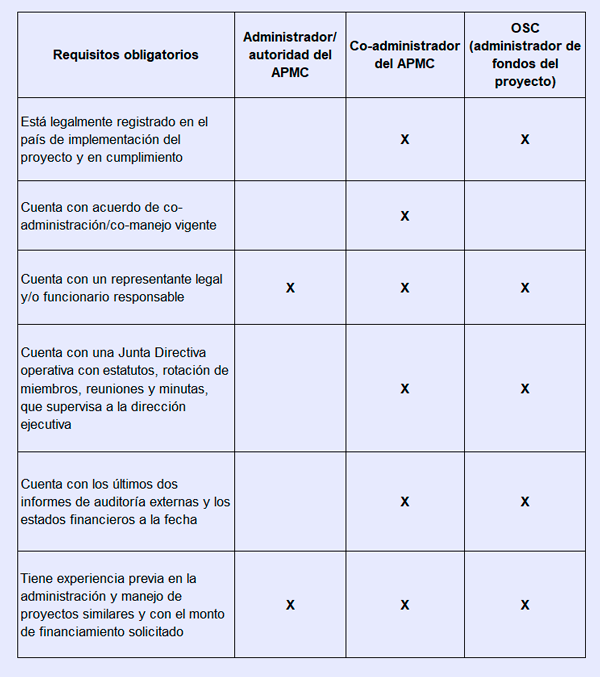
The mandatory requirements that applicants must meet are listed in the table below. In the event that the applicant plans to collaborate with a CSO (which will be responsible for administering the project funds), the CSO’s requirements must also be considered.
The evaluation of CNs will be conducted in accordance with the guidelines contained in the Concept Note Evaluation Matrix and the evaluation of PPs will be conducted in accordance with the guidelines contained in the Project Proposal Evaluation Matrix.
Mandatory requirements for the CN and PP:
- The project will be implemented in at least one of the 14 prioritized MCPAs,
- The MCPA has a current Master Plan/Management Program/Management Plan,
- The proposed project includes in its activities a management effectiveness evaluation (one at the beginning if the MCPA does not have one, and another at the end of its implementation),
- The MCPA has minimum trained staff to implement the project, a headquarters/station, and a minimum budget,
- The applicant provides co-financing of at least 20% of the total proposed project budget (in cash and/or in kind),
- The amount requested is within the established funding limits,
- The project contributes to one or both funding lines of the call for proposals,
- Projects under funding line 1 (“Conservation”) must mandatorily contribute to the following Phase III objective indicator: “O1: Area in hectares with improved conservation”.
- Projects under funding line 2 (“Sustainable Use”) must mandatorily contribute to the following Phase III objective indicator: “O2: Area of relevant ecosystems with more sustainable use”.
- Additionally, the project must contribute to at least two more indicators of the Phase III Logical Framework, which the applicant may select.
- The project is of environmental and social risk level C, B, or B+,
- The implementation period is within the permitted time period,
- It has the endorsement of the national authority, and
- It has the agreement of indigenous and Afro-descendant peoples (if applicable).
Only proposals that meet all requirements, exceed a minimum percentage of 70%, and receive the favorable approval of at least 50% of the evaluation committee members may be selected for financing.
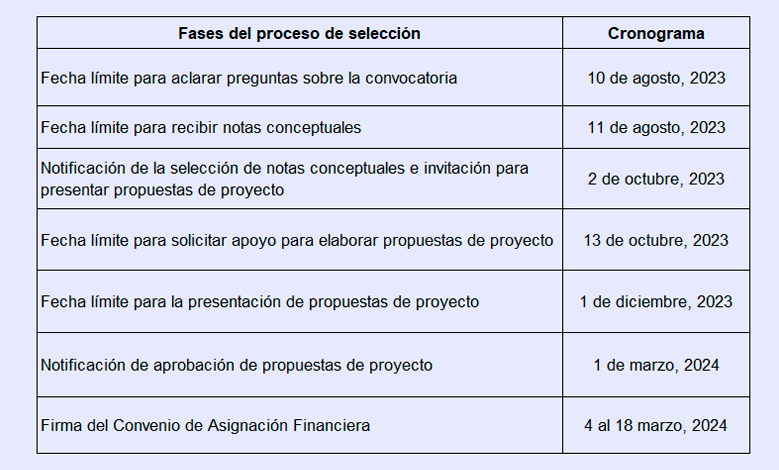
The estimated timeline for the complete call for proposals process is as follows:
Download the call for proposals documents and annexes
- Call for Proposals Guidelines
- 14 APMC
- Phase III Logical Framework
- Table 1 – Fish Spawning Aggregations
- Table 2 – Fisheries Recovery Zones
- Hoja informativa del Phase III Logical Framework
- Concept Note Format
- Concept Note Evaluation Matrix
- PP Development Support Request Form
- Project Proposal Format
- Annex 1 – Project Development Tableo
- Annex 2 – Project Budget
- Annex 3 – Environmental and Social Questionnaire
- Project Proposal Evaluation Matrix
To download all documents in a zip file, click here